
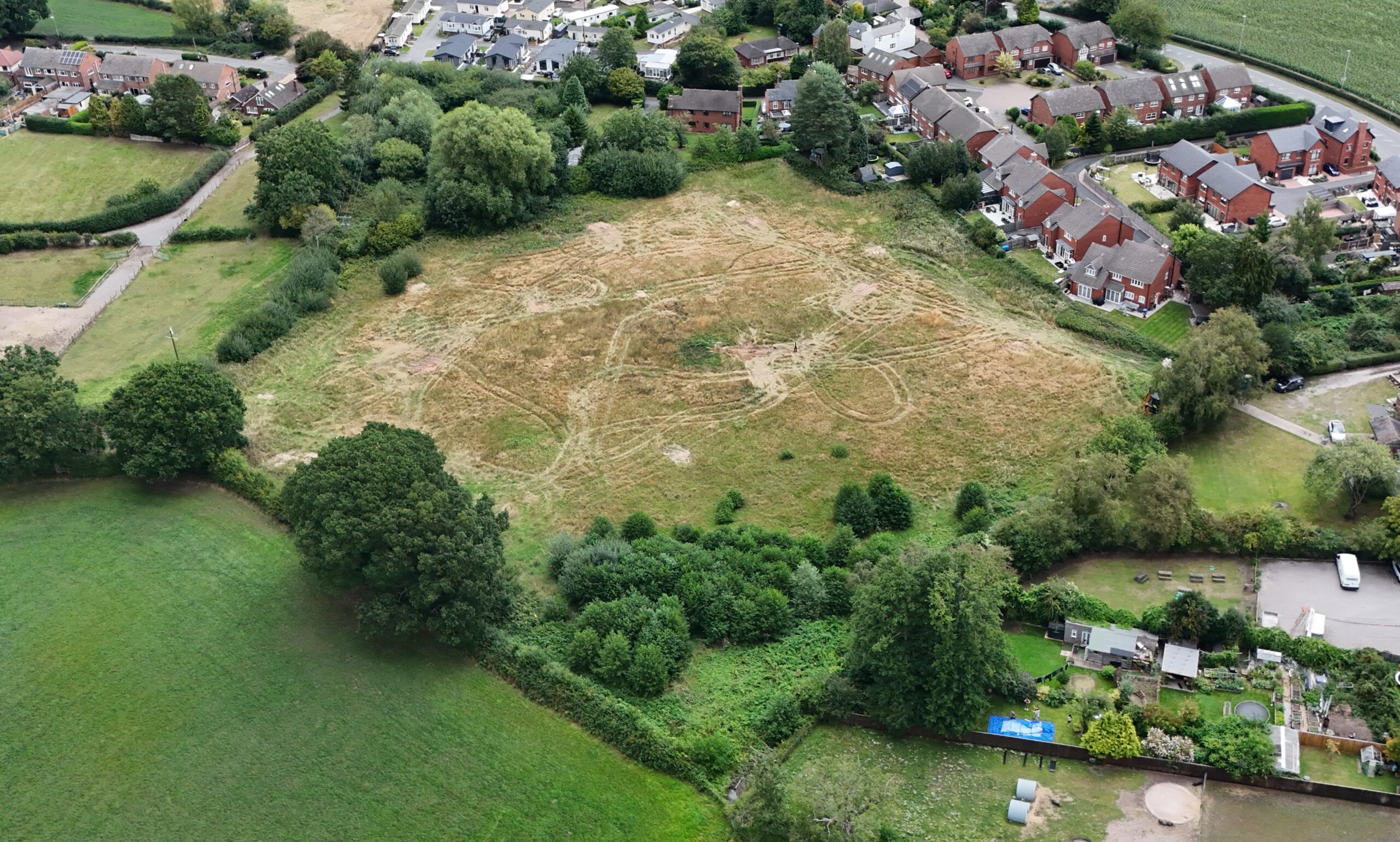
At Crewe Road in Winterley, IGE Consulting worked with Breck Homes to assess ground conditions, including the potential for salt-related subsidence, and recommend how to address this in the foundations of the proposed homes on the site.
We excavated trial pits and drilled boreholes to investigate the ground beneath the proposed homes, with further drilling reaching 18.45 metres below ground level. Although these investigations did not reach the underlying salt-bearing bedrock, they established the conditions above it and informed our foundation recommendations.
We reviewed these findings alongside geological mapping, historical records, terrain data and information from the Cheshire Brine Subsidence Compensation Board, which also suggested that the salt-bearing bedrock lay at considerable depth.
Although no subsidence features were recorded within the site boundary, a hollow approximately 20 metres to the west required closer consideration.
The evidence indicated that this was a longstanding feature likely associated with natural salt dissolution. We found no evidence that historical brine pumping had influenced it, and we did not consider historical salt mining to pose a significant risk to the site.
Taking these factors, and the remaining uncertainty around long-term ground behaviour, into account, we assessed the overall risk of subsidence from natural salt dissolution as low to moderate.
Our recommendations considered the salt-related risk alongside the shallow ground conditions identified during our investigations.
Variable layers of sand and very soft clay made traditional shallow foundations unsuitable. These conditions also ruled out raft foundations and ground improvement using stone columns.
We recommended piled foundations to transfer building loads into stronger ground at depth, combined with reinforced ring beams to provide structural continuity and help accommodate localised variations in ground conditions.
The assessment also highlighted the importance of keeping the piles clear of the underlying salt-bearing bedrock. Our investigations indicated that suitable founding material was available within the deposits above it, subject to detailed design and pile testing.
Our assessment provided Breck Homes and its design team with a site-specific basis for that process, translating a regional geological concern into practical recommendations for the proposed homes.
