
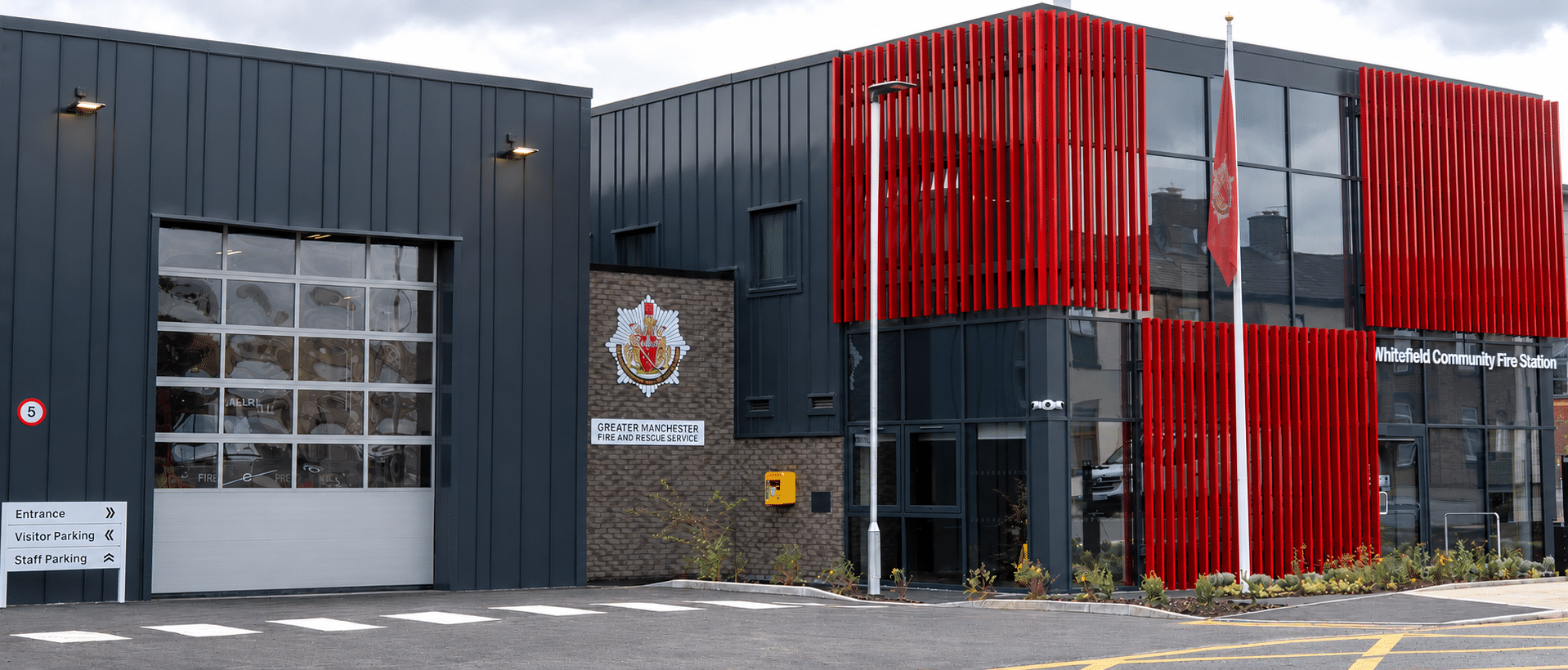
Appointed by the Greater Manchester Combined Authority as part of a 16-year Estates Improvement Programme, IGE Consulting investigated the 0.35-hectare site on Bury New Road while the station remained operational.
Before construction could begin, the project team needed a clearer understanding of the ground beneath the existing station, from potential contamination linked to previous land use to conditions that could affect its foundations.
Our investigations helped the project team plan for the redevelopment of a vital community resource, providing evidence to support the planning application and inform foundation and drainage design.
Emergency vehicles, existing buildings and day-to-day duties restricted access, so we carried out the initial investigation in two phases to reach different parts of the site.
Our desk study identified potential contamination sources, including a suspected former diesel storage tank, hydrocarbon storage and a boiler room. We also identified historical allotments and Made Ground on the site.
These findings guided our on-site work. Boreholes, foundation inspection pits, and laboratory testing helped us understand ground conditions and assess historic land use concerns. Wider environmental testing recorded no exceedances of the commercial land-use assessment criteria used.
A further phase examined PFAS, or per- and polyfluoroalkyl substances, a group of chemicals used in some firefighting foams. None of the PFAS compounds tested were detected above laboratory detection limits.
Ground gas monitoring indicated that no ground gas protection measures were considered necessary.
Together, these findings gave the project team evidence to take a proportionate approach to the environmental risks investigated.
The investigation identified weak organic deposits that could compress under load, together with shallow groundwater. These conditions meant traditional shallow foundations were not considered suitable, and we recommended deep piled foundations, particularly for the new training tower.
The proposed piles would extend into bedrock classified as a Principal Aquifer, an important groundwater-bearing formation, therefore we prepared a piling risk assessment to examine the potential effects on groundwater.
Drainage decisions were impacted. The shallow groundwater and compressible deposits meant soakaway drainage was not feasible at that stage, giving the design team an opportunity to consider an alternative.
Completed by Robertson Construction North West, the new two-storey station and training tower officially opened on October 6th 2026, marking a new chapter for the firefighters and community it serves.
